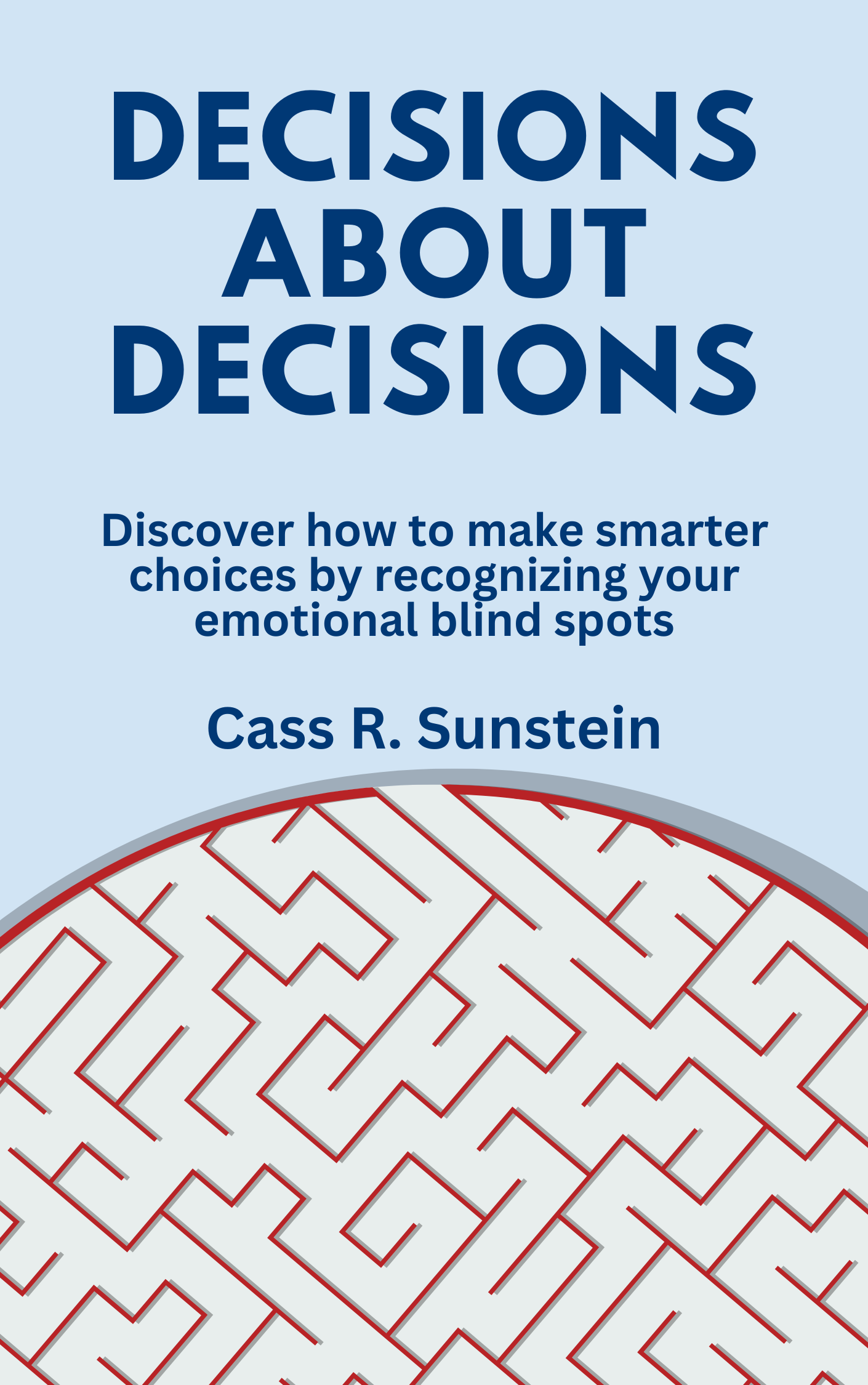
Decisions surround us like an invisible web, silently shaping our lives in ways we rarely comprehend. Cass R. Sunstein's latest work peels back the layers of this complex psychological arena, offering readers a fascinating journey into the heart of human choice-making.A brilliant young philosopher named Frank Ramsey passionately argued that being "thrilled" is not just more pleasant, but fundamentally better for all our activities. This kernel of wisdom becomes the philosophical heartbeat of Sunstein's exploration. Through personal stories and razor-sharp...
The Secret Strategy of Smart Decision-Making
Ever feel overwhelmed by constant decision-making? You're not alone. Harvard law professor Cass Sunstein has cracked a fascinating code that could revolutionize how we handle choices: second-order decisions.Think about your daily grind. Choosing what to eat, which route to take, when to exercise - decisions bombard us constantly. These mental gymnastics drain our energy and create what Sunstein calls "decisional burdens." But what if you could design a system that automatically reduces these burdens?Enter second-order decisions - strategic approaches that...
Transformative Decisions
We've all stood at those moments where a single decision could flip our entire world upside down. But what makes some choices so monumentally different from others? This is the fascinating realm of "big decisions" - those game-changing choices that don't just alter your daily routine, but fundamentally reshape who you are. Opting for a big decision is a life choice that goes beyond standard decision-making. It's not just picking between options, but a transformative leap. They're irrevocable choices made...
Why We Choose to Know (or Not Know)
Have you ever decided not to step on your bathroom scale, even though knowing your weight could help you make better health choices? Sunstein says this is part of a bigger pattern in how we decide what information to seek or avoid. Let's break down why we want (or don't want) information.The foundation of these choices lies in how information provides value. Some information has "instrumental value" - it helps us take action or make better choices. Other times, information...
How We Decide What's True
When researchers gave people news about climate change, something fascinating happened. Those who strongly believed in climate change readily accepted bad news suggesting things were worse than expected, but were skeptical of good news indicating things might not be so dire. Meanwhile, climate change skeptics did exactly the opposite - they embraced positive news but dismissed negative projections.Understand what that means? Rather than neutrally processing all information, we tend to accept what aligns with our existing views while questioning what...
Navigating Our Belief Systems
So what can you do about this tendency to selectively accept information? A lot, as it turns out. You can begin by understanding the complex mix of factors that make us hold onto our beliefs in the first place.When someone believes something strongly, they're not just weighing factual accuracy. They're actually doing a sophisticated calculation of different types of value, even if they don't realize it. These values come in four flavors. First, there's the practical benefit of being right...
Algorithmic Decision-Making
Would you trust an algorithm to make your choices? We're guessing no. One clear reason is that humans like to maintain personal control. Many actively choose to be decision-makers because they value being in charge of their choices, even when they know an algorithm might give better results.This resistance shifts in specific situations and that's why in spite of the human tendency to take charge, algorithmic decision-making is becoming an increasingly popular second-order strategy. For example, when facing technical challenges...
Summary
Wow, what a fascinating journey! The whole idea that we can celebrate not just our decisions themselves, but our freedom to choose HOW we make those decisions is pretty mind-blowing. Make use of the techniques listed in this summary and ace your next set of decisions.
More knowledge in less time
The Art of Community
Get the key ideas from nonfiction bestsellers in minutes, not hours.
Find your next read
Get book lists curated by experts and personalized recommendations.
Shortcasts
We’ve teamed up with podcast creators to bring you key insights from podcasts.
About the Author
Cass R. Sunstein is currently the Robert Walmsley University Professor at Harvard. He is the founder and director of the Program on Behavioral Economics and Public Policy at Harvard Law School. In 2018, he received the Holberg Prize from the government of Norway, sometimes described as the equivalent of the Nobel Prize for law and the humanities. In 2020, the World Health Organization appointed him as Chair of its technical advisory group on Behavioural Insights and Sciences for Health. From 2009 to 2012, he was Administrator of the White House Office of Information and Regulatory Affairs, and after that, he served on the President’s Review Board on Intelligence and Communications Technologies and on the Pentagon’s Defense Innovation Board. Mr. Sunstein has testified before congressional committees on many subjects, and he has advised officials at the United Nations, the European Commission, the World Bank, and many nations on issues of law and public policy. He has served as an adviser to the Behavioural Insights Team in the United Kingdom.
More on: https://hls.harvard.edu/faculty/cass-r-sunstein
Thank you for registering with Storise.
Your journey with books and ideas begins now, anytime, anywhere.
You can now use your registered email to log in to the app.





















.png)