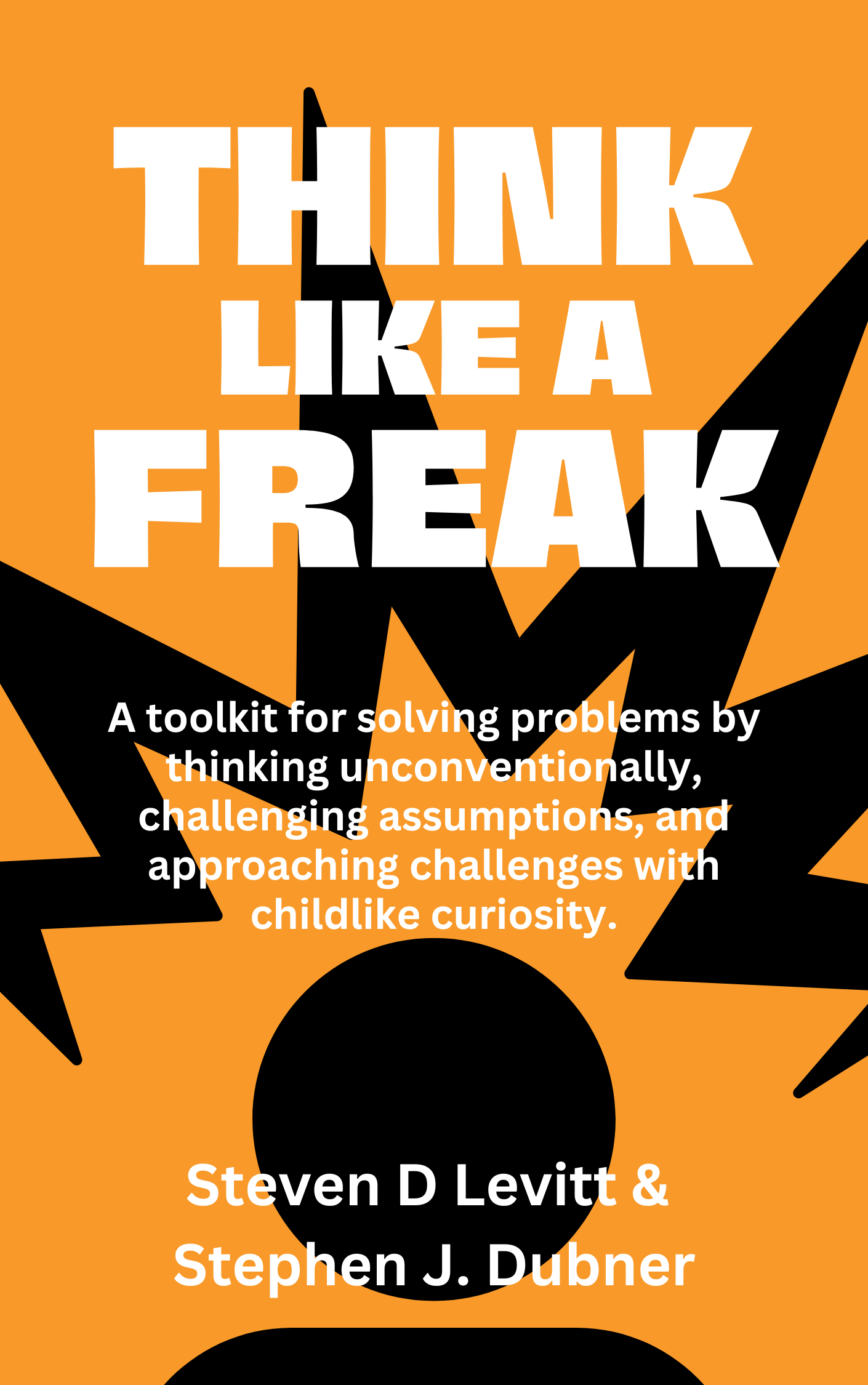
Ever felt stuck when tackling a tough problem? "Think Like a Freak" offers a refreshing approach to problem-solving that breaks free from standard thinking patterns. The authors, known for their previous Freakonomics books, aren't providing another collection of surprising statistics or counterintuitive case studies. Instead, they're sharing their actual thought process—their problem-solving toolkit.You'll learn to admit uncertainty, reframe questions, find root causes, think with childlike curiosity, design clever incentives, and know when to quit. The book uses entertaining stories, like...
What Thinking Like a Freak Really Means
Dubner and Levitt have an awesome approach to problem-solving. The basics of this approach? Challenging conventional thinking. For instance, soccer players taking penalty kicks typically aim for the corners of the goal, giving themselves roughly a 75% chance of scoring. But Dubner and Levitt point out kicks aimed at the center of the goal are actually 7 percentage points more likely to succeed. Why don't more players aim center? The answer reveals a key insight about human behavior. Players avoid...
Freaky Thinkers Have the Courage to Learn
Remember being a kid and making stuff up when you didn't know an answer? Turns out most of us never outgrow that habit. Our reluctance to admit ignorance blocks our ability to learn and solve problems effectively. After all, how can you learn something new when you're pretending to already know it?The problem gets worse when we look at supposed experts. Philip Tetlock, a psychology professor at the University of Pennsylvania, tracked expert predictions in politics over twenty years. These...
Breaking Down the Real Problem
Solving big problems requires courage – not just to admit you don't have all the answers, but to question whether you're even asking the right questions. When we face challenges like climate change or failing schools, our first instinct is often to absorb popular opinions that feel right to us.Take American education reform. The public conversation focuses heavily on teacher quality. Makes sense, right? Good teachers matter. But research shows home factors like parental involvement and early childhood learning have...
The Real Solutions Hide Below the Surface
Most of us are a bit lazy when solving problems. We grab the first explanation within reach. But for society's bigger challenges, truth is rarely sitting right on the surface, waiting to be spotted. Instead, it's buried deep in the roots, requiring some serious excavation work.Take poverty and famine. The obvious answer seems straightforward: poor people need money, and hungry people need food. So we send planes full of cash and food to troubled areas. Problem solved, right? Not quite....
Be A Child For Once!!!
Y'know, we adults could solve a lot more problems if we borrowed a few thinking strategies from eight-year-olds.You might be wondering if "thinking like a Freak" is just code for "thinking like a child." Well, not entirely - but there's a lot to gain from channeling your inner kid when tackling tough problems. Children approach the world with relentless curiosity and fewer biases. They haven't yet learned to rule out solutions because they seem too simple or unconventional. They blurt...
Incentives Make Us Dance
Ever noticed how quickly kids learn when candy's involved? Yeah, it works on adults too. Sorta. Adult incentives aren't always straightforward. Financial, social, moral, and legal incentives all push people's buttons differently and with varying strength. To think like a "Freak," and to move people in the direction you want, you need to become a master of incentives—the good, the bad, and the ugly.Plus, determining someone's true incentives can be tricky. People often say one thing and do another. Psychologist...
Clever Traps Expose Hidden Motives
King Solomon and David Lee Roth make an unlikely pair. One built the First Temple in Jerusalem and was celebrated for his wisdom. The other fronted the rock band Van Halen and was known for excessive behavior. Yet these two figured out something profound about human nature: if you understand what motivates people, you can design clever traps that make the guilty expose themselves.Solomon faced a dilemma when two women claimed the same baby. Dude proposed cutting the infant in...
Changing Stubborn Minds
So you've got a brilliant idea that could change the world—or at least win you that argument at the dinner table. There's just one problem: the person you need to convince doesn't want to be convinced. What now?Dubner and Levitt have some bad news for you right off the bat: persuading someone who doesn't want to be persuaded is incredibly difficult. They actually recommend just smiling and changing the subject if you can. But if you're backed into a corner...
Walking Away Might Be Your Smartest Move
"Never give in, never give in, never, never, never." Winston Churchill's words echo through history as the ultimate anti-quitting manifesto. We've all heard similar advice: "Winners never quit, and quitters never win." It's practically carved into our cultural DNA.But here's the thing - that advice is often dead wrong.Sure, if you're the prime minister of Great Britain fighting Nazi Germany's existential threat, sticking it out makes perfect sense. For the rest of us regular folks facing everyday decisions? Quitting can...
Summary
So there you have it! Thinking like a Freak isn't about being weird for weirdness' sake. It's about breaking through those mental blocks and artificial limits we place on ourselves. Next time you're stuck on a tough problem, ask yourself: "What would a Freak do?" The answer might surprise you—and lead to breakthrough solutions others would never discover.
Now go out there and think differently. The world needs more Freaks!
More knowledge in less time
The Art of Community
Get the key ideas from nonfiction bestsellers in minutes, not hours.
Find your next read
Get book lists curated by experts and personalized recommendations.
Shortcasts
We’ve teamed up with podcast creators to bring you key insights from podcasts.
About the Author
Steve is the host of People I (Mostly) Admire and co-author of the Freakonomics books, which have won many awards and sold millions of copies around the world.
He is also the William B. Ogden Distinguished Service Professor of Economics at the University of Chicago, where he directs the RISC Center (Radical Innovation for Social Change). He has been named one of Time magazine’s “100 People Who Shape Our World,” and is a recipient of the John Bates Clark Medal winner, which recognizes the most outstanding U.S. economist under age 40. Steve received his B.A. from Harvard in 1989 and his Ph.D. from M.I.T. in 1994 (both in economics), and has taught at the University of Chicago since 1997.
Thank you for registering with Storise.
Your journey with books and ideas begins now, anytime, anywhere.
You can now use your registered email to log in to the app.






















.png)