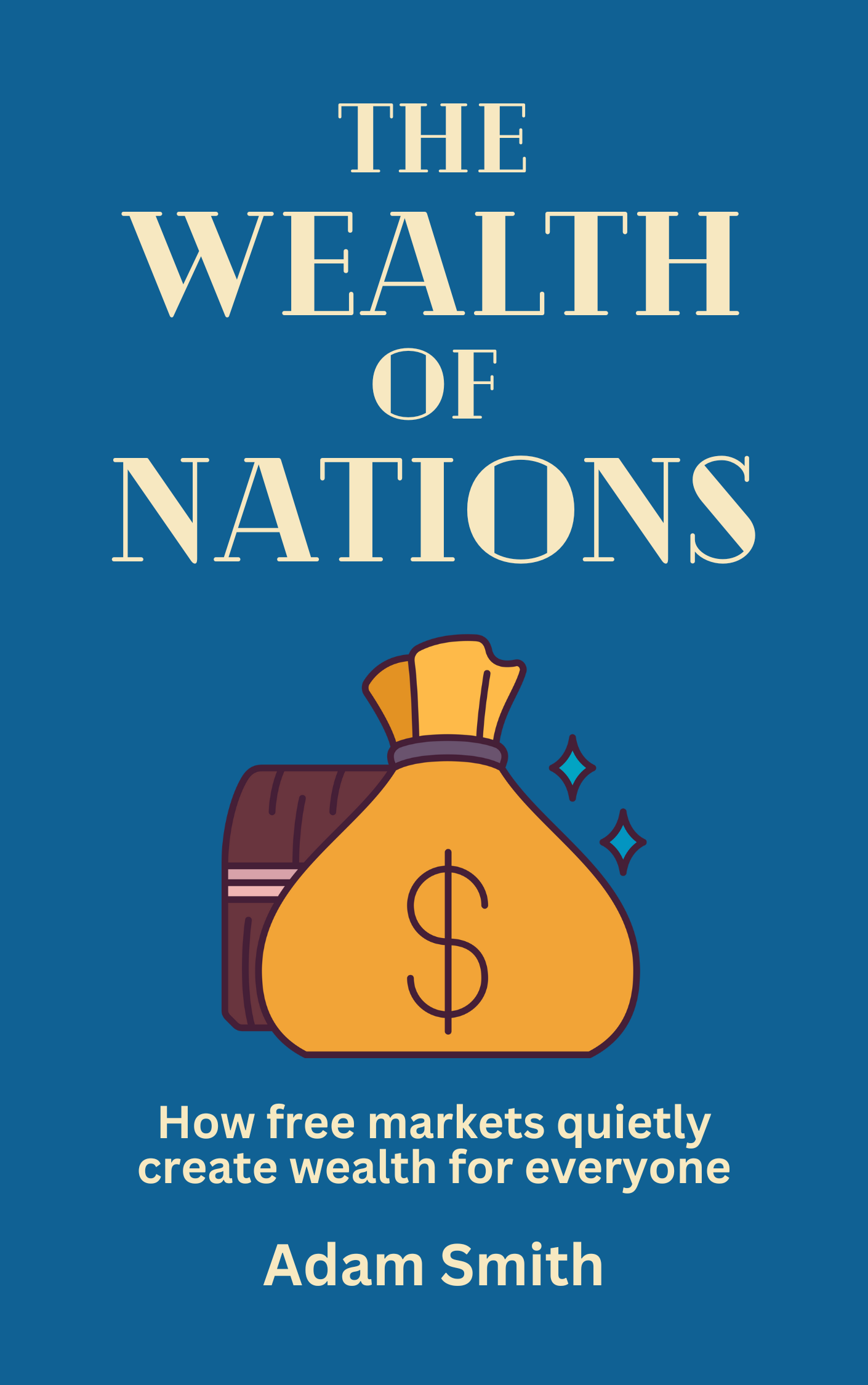
What Really Makes a Nation Rich?When people think of wealth, they often imagine gold bars, stock markets, or giant corporations. But in An Inquiry into the Nature and Causes of the Wealth of Nations, published in 1776, the big idea is something far more grounded—and revolutionary. True wealth, Adam Smith argues, isn’t about hoarding treasure. It’s about productivity. It’s about how efficiently a nation’s people can create goods and services, and how freely they can exchange them. At the heart...
The Power of Specialization: Why We Work Better in Pieces
If you’ve ever tried to cook a meal, host a dinner party, and do the dishes all at once, you already know that doing everything yourself is exhausting—and inefficient. Now imagine applying that logic to a whole economy. The key to productivity, it turns out, is specialization. When people focus on one part of a task instead of doing everything themselves, output doesn’t just improve—it skyrockets.One of the clearest illustrations of this is the pin factory example. A single person...
The Invisible Hand: How Self-Interest Serves the Whole
Imagine walking into a crowded market. Vendors shout prices, buyers haggle, and deals are made everywhere you turn. It feels chaotic, but somehow, it works. No one’s in charge of the entire market, yet it functions smoothly. This is the invisible hand in action—a concept that captures how individual self-interest can unintentionally benefit society at large.When someone opens a bakery, they’re not thinking about feeding the neighborhood—they’re thinking about making a living. But to succeed, they have to meet the...
Let Trade Flow: Why Open Markets Create More for Everyone
Money solved a big problem in early marketplaces. When a butcher wanted bread but the baker didn't want meat, direct trading hit a wall. That's where money stepped in. The butcher could sell meat to anyone willing to buy it, then use that money to purchase bread. This simple innovation freed people from the constraints of direct exchange and allowed them to specialize fully in their crafts. People could just specialize, trade, and enjoy better benefits. This simple idea explains...
Self-Interest, Not Selfishness: How Mutual Benefit Works
There’s a common misunderstanding that looking out for yourself means disregarding others. But self-interest, in a well-functioning economy, is something very different from selfishness. It’s about making choices that benefit you while also respecting the interests of others.Think of a tailor who opens a shop. Her goal is to earn a living, not to clothe the neighborhood out of kindness. But she knows that unless she offers clothes that people like, at prices they’re willing to pay, she won’t succeed....
The Role of Government: Not to Control, But to Support
It’s easy to assume that if markets work so well on their own, there’s no need for government at all. But that’s not quite the case. Markets need a solid foundation—rules, institutions, and protections that keep things fair and functioning. Government, in the right role, doesn’t strangle the economy; it strengthens it.The most basic job of government in an economic system is to protect people and property. If workers aren’t safe, or if businesses fear that contracts won’t be honored...
Labor Is the Real Source of Wealth
Capital comes in two flavors that work differently in the economic recipe. Fixed capital stays put while working for you—think of machines, buildings, or equipment that generate value without changing hands. Your pizza oven bakes thousands of pies but remains yours. Circulating capital, however, must leave your possession to make money—like inventory that's sold or raw materials transformed into products. The flour becomes dough becomes pizza becomes profit. Both types fuel growth, just through different economic pathways.But if you strip...
Long-Term Growth Comes from Simple, Repeatable Exchanges
Long-term economic growth comes from ordinary people making small exchanges, over and over again, in a system that lets those exchanges grow.This cycle of exchange, repeated thousands of times a day across a society, creates momentum. More trade means more specialization. More specialization means more output. And more output means more to trade. It’s a quiet engine of compounding productivity that pushes the economy forward.This process doesn’t require any one person to understand the big picture. Each individual focuses on...
Summary
Small Freedoms, Big Prosperity
The big lesson from The Wealth of Nations isn’t about chasing riches or building empires. It’s about trust in small, everyday choices. When people are free to work, trade, and specialize within fair systems, something remarkable happens: wealth grows—quietly, steadily, and often unexpectedly. Prosperity, it turns out, isn’t the result of control, but of letting go.
More knowledge in less time
The Art of Community
Get the key ideas from nonfiction bestsellers in minutes, not hours.
Find your next read
Get book lists curated by experts and personalized recommendations.
Shortcasts
We’ve teamed up with podcast creators to bring you key insights from podcasts.
About the Author
Adam Smith was a Scottish philosopher and economist known as the "father of modern economics," whose 1776 book, The Wealth of Nations, argued for free markets and against mercantilism. He proposed that individual self-interest, guided by the "invisible hand," could benefit society as a whole. Smith's work introduced key concepts like the division of labor, which enhances productivity, and is considered the foundation of classical economics.
Thank you for registering with Storise.
Your journey with books and ideas begins now, anytime, anywhere.
You can now use your registered email to log in to the app.























.png)